With weekend lockdowns and age-specific restrictions, Turkey takes a different coronavirus approach
Taksim Square's flocks of resident pigeons, normally waddling around with full bellies thanks to cups of grains that children toss at them, swoop unhindered straight at the heads of the few passers by, mostly policemen and media.
It feels more like a scene from Alfred Hitchcock's horror thriller "The Birds" than one of Istanbul's most crowded squares, normally teeming with Turks and tourists alike.
Then again, nothing about the impact Covid-19 is having across the globe is normal or familiar.
Last weekend, the Turkish government implemented a 48 hour curfew for 31 provinces, impacting three quarters of Turkey's population.
And while critics of the government have been calling for these types of severe measures to curb the rise of Covid-19, the initial outcome was disastrous.
The curfew was announced just two hours before it was to go into effect causing a buying panic in some areas as people flocked to grocery stores and bakeries with little regard for social distancing measures.
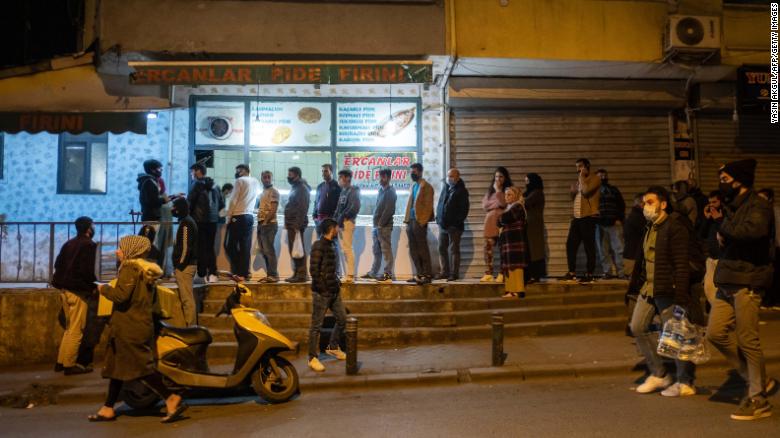
Social media was flooded with coronavirus dark humor: a husband caught in breach of the curfew fleeing the scene leaving his car and wife behind; a man who tries to dodge the penalty fee by saying he doesn't speak Turkish, but the police figure out that he does.
Following the chaos around the curfew, President Recep Tayyip Erdogan addressed the nation, arguing that Turkey is strong enough to protect and provide for its citizens, while urging the population to stay at home, and announcing another weekend curfew.
In confronting coronavirus, Turkey is charting its own path as it does in so many other ways.
During the week, the stay at home order only applies to those under the age of 20 or over 65. All other citizens are in theory allowed to go out, although many small businesses are closed, restaurants are open for delivery or pick-up only, public places like parks are off limits, and banks have limited hours.
By contrast, construction sites are in full swing, along with factories and other businesses that are unwilling to take an economic hit.
Some experts say partial restrictions like Turkey's can be successful as long as those who are vulnerable continue to be protected and those who do venture out follow the appropriate measures.
"It's an alternative strategy," said Dr. Muhammad Munir, a virologist at Lancaster University in the United Kingdom, explaining that healthy people going out for routine shopping does not necessarily do any harm.
"Eighty percent of the people infected have recovered. So, if it's healthy people who don't have underlying causes, then that is absolutely helpful. The only benefit of a lockdown is that the spread of the disease will be slow, the pressure on the hospitals will be reduced."
Dr. Jeremy Rossman, a honorary senior lecturer in Virology at the University of Kent says it's tricky given the numbers of cases that Turkey is reporting daily, and that partial lockdowns are only really effective when done early on and a country still has a low level of cases, or if a country has already peaked and is coming out of a full lockdown.
"At [Turkey's] level, most countries are implementing a full lockdown. A partial lockdown can be good, it can balance keeping some of the economy functioning while still trying to contain the outbreak" He says. "It depends on how well the population is adhering to the guidance and how well physical distancing and hand hygiene are being implemented in workplaces. But at the rate Turkey is going right now, there is risk this won't be sufficient."
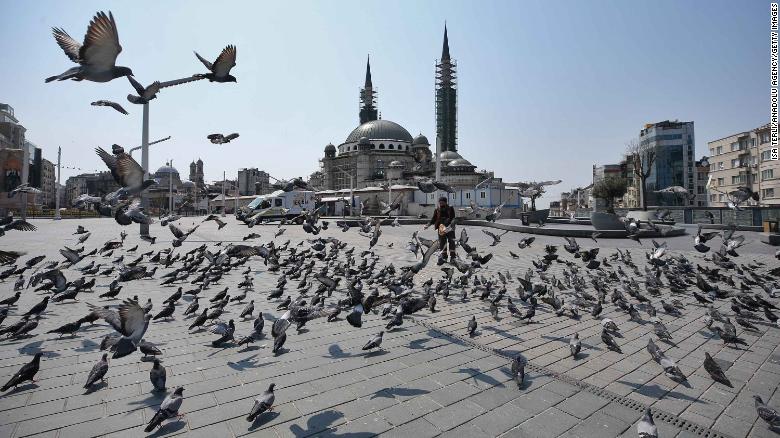
Pigeons fly around a deserted Taksim Square after a two-day curfew imposed to stem the spread of coronavirus in Istanbul.
Turkey is among the top 10 countries in the world when it comes to confirmed coronavirus cases, and its toll is increasing by more than 4,000 cases per day. And the mortality rate has been much lower here than elsewhere which has raised eyebrows.
The Turkish Medical Association (TMA) says Turkey's official coronavirus death statistics do not include cases that strongly indicate Covid-19 but test negative.
"Doctors that belong to our association have reported that even those CT scans and/or clinical findings indicate the disease, if PCR test results are not positive, if the patient dies they are not recorded as Covid-19," the TMA said in their report. CT scans are imaging tests, while PCR tests are used to detect the RNA of the virus.
Turkish Health Minister Fahrettin Koca argues that Turkey's mortality rate just above 2% is due to the country's large healthcare capacity and a treatment protocol that is different than other countries.
Koca says that, unlike other countries, Turkey's approach to fighting Covid-19 centers around contact tracing instead of general testing or testing after clinical presentation.
They have also been delaying intubation by using high frequency oxygen for a longer period of time, which he says has yielded better results.
And Turkey uses the malaria drug hydroxychloroquine and favipiravir, a Japanese antiviral, much earlier than other countries in the onset of Covid-19, Koca says.
But Lancaster University's Dr. Munir is one of many medical experts who opposes the use of the malaria drug.
He said the risk of the side effects outweighs any benefit that using hydroxychloroquine may have.
"Treatments have very little impact," he explained. "When it comes to hydroxychloroquine, the patients might have recovered from Covid-19 anyway, but after a year they might see heart problems coming back, that blindness is appearing. This is why there isn't enough evidence to approve these drugs on a mass scale."
"We are trying to save lives," says Dr. Nuri Aydin, the president of Istanbul University-Cerrrahpasa School of Medicine, one of the hospitals leading Turkey's response. "What we have seen is that the time that the patients spend in the ICU decreases when they take hydroxychloroquine before they reach the stage where they have to enter the ICU."
Aydin says there isn't enough data to publish their findings yet and that "time will show us the real results." And he adds that they are doing something else differently: Rather than having their patients lying face up, they are keeping many in the prone, ie face down, position. This, he says, has yielded positive results as well. And Turkey has started using plasma from patients that already contracted the disease on those that are still fighting it.
The government says its ICUs still have plenty of capacity and there is no shortage of hospital beds. And Turkey, which did not report its first case until mid-March, had time to prepare. Indeed, Turkey's hospital system is so good that the country has become a medical tourism destination.
In response to Covid-19, the country quickly developed programs to manufacture and distribute personal protective equipment (PPE) not just within Turkey itself, but overseas as well sending cargo loads to more than 30 countries, including the UK, Spain, and Italy.
The gesture of solidarity and goodwill is also perhaps aimed at rebuilding Turkey's frayed ties with its NATO allies.
Ministry of Education vocational schools in Istanbul and elsewhere have been turned into workshops churning out face masks, body suits, and surgical gowns intended for in country use.
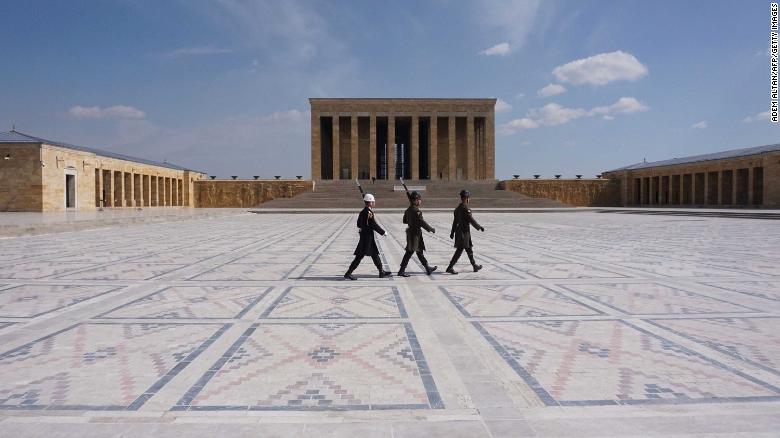
Soldiers walk at the empty mausoleum of the founder of the Turkish Republic Mustafa Kemal Ataturk in Ankara on March 23.
Others produce face shields and gallons and gallons of disinfectants, hand sanitizers, and other essential cleaning products. Masks are obligatory in public places like markets, but are not sold anywhere anymore.
That was banned because the government is distributing them free at pharmacies, or for those who can't go out, straight to their homes.
Turkey is easing the burden of the epidemic on those under stay at home orders by sending volunteers and police door to door to make sure vulnerable people have the services they need.
Call centers called "Acik Kapi" Open Door area located in every district where those elderly citizens under stay at home orders can call in requesting anything from a grocery delivery, pharmacy purchase or their monthly retirement cash.
Eyup is one of Istanbul's populous historic districts, where the phone rings nonstop.
Serdar Karakus, a school headmaster's assistant, and Ugur Uyan, a neighborhood mosque imam, have been authorized to withdraw people's retirement funds and deliver them to citizens who request their service.
They are both volunteers who say they do this as their duty to their country and their people.
"My parents are elderly. I live in Istanbul. They live in Manatya. They are receiving this service where they are because I am not there to help them," Karakus said. "But someone there is. So to do this for the elderly here, it's like I am doing it for my own parents."
A few hours later we join a group of policemen who are doing the rounds handing out face masks and Kolonya, a traditional Turkish version of hand sanitizer made up of 80 percent alcohol, usually scented with lemon fragrance.
Sadet Seker, in her 70s, lives alone. Her husband passed away years ago. She speaks to her children regularly on the phone.
But the last time she hugged them the last time she had physical contact with them was two or three months ago. She's not sure. We ask if they are in Istanbul.
"Yes, they are in Istanbul," she replies and then starts to shake, her eyes filling with tears.
They are so close, and yet they might as well be so far away. How soon she can actually see them will depend on whether or not Turkey's Covid-19 strategy is a successful gamble.
Yorumlar
Yorum Gönder