A public inquiry into the UK's coronavirus response would find a litany of failures
Any self-respecting pandemic crisis team should have realised the importance of mass testing from the outset
•Anthony Costello is a former director of maternal and child health at the World Health Organization
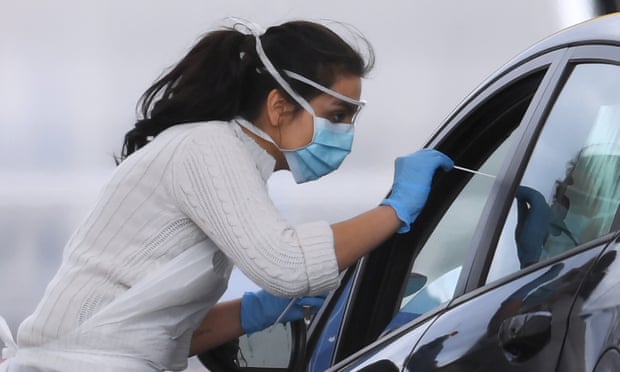
Nine weeks after the virus first appeared in Wuhan, England and Wales still lack the necessary testing capacity and surveillance infrastructure to shut down the epidemic.’ A drive-through testing facility at Ikea in Wembley, north-west London Photograph: James Veysey/Rex/Shutterstock
Will the inevitable public inquiry into the UK’s Covid-19 response pin the blame on a few scapegoats? I hope not. Britain’s failure to move quickly and effectively is the symptom of a more comprehensive system failure. More than three months after the virus first appeared in Wuhan, England and Wales still lack the necessary testing capacity and surveillance infrastructure to shut down the epidemic. Crucial frontline workers are still doing their jobs without adequate personal protective equipment. Public Health England (PHE) seem unable to increase the daily number of tests in line with European neighbours. As other countries acted swiftly to contain the epidemic, the UK appears indecisive and delayed, shifting late in the day from a controversial herd immunity strategy to a lockdown. History won’t look kindly on Britain’s response.
We must ask at least five far-reaching questions about how our health system deals with a pandemic. First: who’s in charge? Many actors have been involved in devising a response to coronavirus – Downing Street and its advisers; Cobra; the Department of Health and Social Care; NHS England; PHE and its Scottish, Northern Irish and Welsh counterparts; the National Institute for Health Research; the chief medical officer, Chris Whitty; the chief scientific adviser, Sir Patrick Vallance; and the Scientific Advisory Group for Emergencies (UK Sage). Coordination appears chaotic. I’ve reliably been told that leaders across these various bodies often don’t know what each other is doing.
The second question concerns history. The UK’s haphazard coronavirus response wasn’t just a result of chaotic planning. The groundwork was laid years ago. During the last decade, funding for public health has been fragmented and downgraded. In 2013, the Lansley reforms created PHE, a new executive agency within the Department of Health and Social Care that was separate from the NHS. Its mission was to protect and improve the nation’s health in order to address inequalities. Its funding came from local authority budgets; as local authorities suffered the sharp end of austerity, funding for PHE stagnated. Spending on the public health grant in 2019-20 was £850m lower in real terms than initial allocations in 2015-16.
Today, the repercussions of fragmentation and underfunding are clear. Scaling up Covid-19 testing requires a community surveillance system that integrates PHE local outbreak management teams with NHS primary care facilities and laboratories. In its 3 March Covid-19 action plan, PHE assured us that “once a case has been detected, our public health agencies use tried-and-tested procedures for rapid tracing, monitoring and isolation of close contacts, with the aim of preventing further spread”. By all accounts, this didn’t happen at scale. On 12 March PHE stopped all community testing as part of the government’s delay strategy, instead focusing its efforts on patients and health workers.
The third question is political. This epidemic has tested the reigning political emphasis on market mechanisms and public-private partnerships, and found it wanting. During a national epidemic, our system of outsourced providers and internal markets simply doesn’t work. As one senior British doctor close to the Covid-19 crisis organisation told me, the chaos of the UK’s response has “reflected the wholesale destruction of a coordinated and focused state sector. Outsourcing, delegated powers, internal markets … have made a single response impossible. It is affecting every aspect of policy.”
A fourth question concerns the pool of experts advising the government. Vallance has stated that UK Sage comprises the best of British science – with expertise in virology, mathematical modelling and behavioural science. But for an overall crisis response, UK Sage was too narrow in scope. It needed public health science, logistics, IT, social and citizen science, communications and community mobilisation expertise at the table. Government funding for health has always had a strong bias towards clinical medicine. According to one 2018 report from Nesta, 94% of all health research funds are spent on clinical medicine, drugs and biosciences; only 6% is divided between psychology and behavioural sciences, and public and community health. During an epidemic, public health expertise is vital.
But perhaps the gravest problem with the UK’s response is that it didn’t act sooner. The 12 March decision to stop community testing meant the government effectively gave up on containing the spread of the epidemic. In South Korea, regional data and maps about coronavirus deaths are available online, and virus test data shows that just two out of 18 regions account for 84% of cases. The UK doesn’t have a reliable regional data bank because it collected too little community information. Where South Korea and China used digital apps to assist contact tracing, clinical deterioration and quarantine compliance, NHS Digital has simply recorded data since 18 March on 111 calls and online assessments. This data is not linked to community case surveillance or quarantine.
Maybe it is already too late in the day for the government to remedy these mistakes. Pandemics move fast; if you don’t get ahead of a virus, it quickly spreads. The government stuck stubbornly to its delay policy to “flatten the curve” through social distancing alone, despite the evidence of epidemic suppression through testing in South Korea, Singapore, Hong Kong, China, Taiwan and Germany, which have all recorded lower death rates.
On 23 March Paul Romer, a Nobel prize-winning economist, wrote a blogpost about his models of social distancing and community mass testing. “If we contrast a nonspecific policy of social distance with a targeted policy guided by frequent testing … how much more disruptive is the nonspecific policy? Answer? Way more disruptive.” Though an economy can survive with 10% of its population in isolation, it can’t survive when that figure is 50% or above. Without community surveillance and testing in place to detect new outbreaks and isolate individuals once the current lockdown is lifted, we face hugely damaging national lockdowns, over and over again. Any self-respecting Cobra, UK Sage or pandemic crisis team should have realised the importance of mass testing from the outset, and never allowed this to happen.
• Anthony Costello is professor of global health and sustainable development at UCL and a former director of maternal and child health at the WHO
Yorumlar
Yorum Gönder