Coronavirus: Why are British travellers struggling to get home?
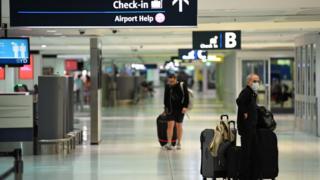
Around the world there are thousands of Britons desperate to get home. And yet many are stranded.
Airports have been closed and borders shut. Cities have been placed in lockdown. Many are trapped in hotels, often with money and food running out.
They are sitting on the phone calling airlines or tour operators, on hold for hours or failing to get through at all. They are emailing, phoning and messaging the local British embassy, often to no avail.
In hundreds of posts and videos on social media, they are voicing their frustration from all corners of the world and asking - why is more not being done to help them?
Well, here's why.
- The scale of the challenge is unprecedented
No-one knows how many Britons are travelling abroad at any one time. The UK is not a police state and does not require its citizens to register every time they leave. Foreign Secretary Dominic Raab told MPs recently it could be anything between 300,000 and a million people at any one time.
These travellers are not on any list and are dispersed to the four winds. Many are not in capital cities but confined instead by local curfews in provincial towns. Some will be in places that are within easy reach. Others will be in locations where there are no direct flights to the UK even in normal times.
Getting such numbers home is an unprecedented, historic task and will not be solved by asking British Airways to arrange a few flights.
- The Foreign Office is not geared up to handle the crisis
The FCO is largely a diplomatic machine, designed to develop and implement foreign policy and promote British interests overseas. It has a consular arm, of course, to help Britons in trouble overseas but it is not designed to deal with something of this scale.
The crisis centre in the bowels of King Charles Street was set up in 2012 so the FCO could handle two incidents in different places at the same time, such as an earthquake and a tsunami. It was not designed to handle a global consular crisis with many thousands of Britons simultaneously stranded round the world.
To give you a sense of context, according to the latest FCO accounts, in 2018/19, the department helped more than 22,000 British people in new consular cases around the world, and ongoing support to 7,700 existing cases. They are now having to cope with hundreds of thousands at the same time.
So as a result the FCO is having to reconfigure itself in the midst of the crisis. Whole departments have been closed down and staff redeployed to help handle the crisis.
After the 2017 hurricanes, the FCO trained 20% of its staff - about 550 people - to be able to respond to crises. Now almost the whole of the FCO is being retasked.
- The consular call centres have been overwhelmed
If you ring up an embassy and you cannot get through, or it is a weekend, you will almost certainly be put through to the FCO's central consular contact centres.
These are located, perhaps surprisingly, in Malaga and Ottawa. They were set up in 2011 to help handle basic queries so embassies and high commissions could focus on more important cases.
In the whole of the financial year 2018/19, these two call centres received 350,000 calls. The vast majority were sorted out without having to contact the relevant embassy for a reply.
In contrast, on one day recently, Malaga handled 28,000 calls alone. As a result the FCO has in recent days tripled the capacity of its call centres.
- Countries are reluctant to open their airspace
Governments have closed their airports for a reason. They are petrified that coronavirus might spread. They know that if they make an exception for the UK, then many other countries will demand an exception too.
So British diplomats are having to call in favours to try to persuade counterparts to lift the lockdown temporarily. The Foreign Secretary has spoken to more than 30 other foreign ministers in recent days trying to get them to open up their airspace.
Deals are being done. Some countries are helping each other bring their nationals back, trading seats on flights. But this diplomacy is hard and it takes time.
As well as talking to ministers and officials, British diplomats are also having to negotiate with military chiefs who are often in charge of national airports.
- Fixing flights is not easy
Once the UK has persuaded a country to open its airports, it then has to persuade the airlines to put on some commercial flights. This is easier said than done.
Airlines are businesses and they have to be convinced and paid to put on flights. That means they need a clear sense of passenger numbers and that can be hard to confirm. Governments cannot force airlines to reduce their prices.
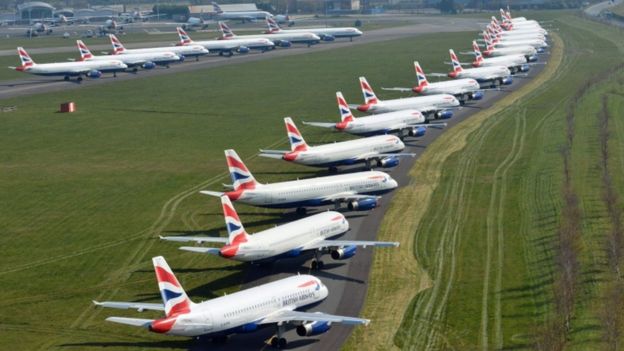
There might be many planes sat on the ground at airports round the world. But the airline industry is highly regulated and getting the right permissions and slots takes time.
Oh, and the Royal Air Force does not have enough transport planes to solve the crisis, in case you were wondering.
- Actually many Brits are getting out
For all the many difficulties that some British nationals are experiencing, many others are getting home.
According to the FCO, more than 200,000 Britons have been helped to return home from Spain since the authorities announced travel restrictions.
Since March 16, when Egypt first began suspending flights, the Cairo embassy has helped more than 12,000 Britons return home on 53 flights.
Over the last couple of weeks, the ambassador in Morocco, Tom Reilly, and his team have helped 8,500 British nationals get home on 49 commercial flights despite the travel restrictions.
More than 1,900 Britons have been repatriated on special charter flights from cruise ships docking in Japan, California and Cuba.
Some 1,400 have come back on FCO charters from Peru and China. About 4,000 have been helped back from Jamaica.
Around 500 have left Bali after the FCO helped unblock visa complications.
And the FCO has persuaded Qatar Airlines to open up their route from Australia, providing 3,500 seats for Britons each day since last Friday.
Yorumlar
Yorum Gönder